
We woke Saturday morning relatively early considering our late night of swimming and we were on the road by 9 a.m. or so. Our destination was the Laura Ingalls Wilder Museum but on the way we serendipitously stopped for some much needed gas. That decision was fortuitous not because of the gas that was about $.25 cheaper a gallon than in Wisconsin, but because while we were there we looked through some brochures we had in hand and decided that, since it was so close, we'd take an unplanned detour and tour the Sod House on the Prairie, which ended up being one of the highlights of our trip.
The Sod House on the Prairie isn't connected to anything Laura Ingalls Wilder, at least not officially and, really, until we got there we weren't quite sure what it was. It rests on an ordinary Minnesota working farm that just happens to be owned by a history buff. In the 1980s, I believe, the history buff decided he wanted to make a sod house as it would have been made in the time of the early settlers. He set about doing research, finding untouched sod and began his project.
What stands there today is a roomy sod house, an outhouse, a sod dugout house (much like what the Ingalls family lived in when they first settled in Walnut Grove), and a small log cabin. These buildings are surrounded by natural prairie grass (but for the path that's been mown for easier walking; surely the owners don't want tourists getting lost in the prairie grass on their farm like Laura and Carrie Ingalls did in one of the Little House books).
First on the self-guided tour wass the sod house.

The inside was rife with dresses, aprons, bonnets, and other prairie-wear and the kids wasted no time donning the trappings of prairie life in the late 1800s.

The inside was so fun and interesting too. Not only could you see what the inside of a sod house might have looked like, but unlike most historical sites, you could touch, sit, and explore the furnishings and pretend you were living in that house.

Incidentally, the stove Madeleine is slaving away over in the photo above is the same stove Dad said he had in his childhood home in the 1940s only miles away on a farm in this part of Minnesota.
After leaving the sod house, we continued on down the path towards the sod dugout.

Diana and I both agreed that if we'd had to live for any considerable amount of time in a sod dugout, chances were good our families wouldn't have made it. Dirt floors, ample room for mice, snakes and who knows what else to get in, not even to mention the time and effort to create heat, food, clothing, etc. I just can't imagine.

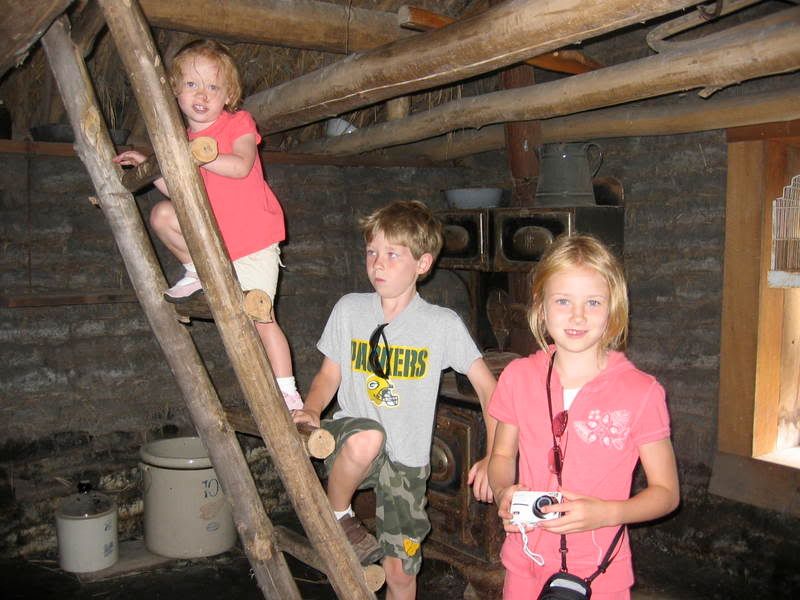
I don't know if you can get an idea from the picture above, but that one room and loft was about the size of the dugout house the Ingalls family moved into just outside of Walnut Grove (the book correlation is On the Banks of Plum Creek ). At that time I believe the Ingalls family consisted of Pa, Ma, Mary, Laura and Carrie, which is the exact size of my family. That room the kids are standing in was NOT large. Oh, and Madeleine took a dim view of the idea that a bed might simply have ropes tied across for a mattress.
We had such a fun time exploring these homes, imagining what life was like for the people that lived in homes like them and, luckily, talking to the owners of the farm about how the homes came to be built and even about their appearance in a History Channel show called "Save Our History" (they appeared in an episode titled "Frontier Homes").
An unplanned stop, but like many other things in life, it's often the unplanned events that are the most notable, and that was true in this case.


